Hi, what a month!
As a point of order in organizing this month’s newsletter, you’re probably aware that I try to start with international and national updates, then zoom in to local government, and end on a spotlight of different labor struggles in the valley. As much as these categories are arbitrary to begin with, the sheer number of major developments throughout this month just about does away with them entirely. Please feel free to navigate based on the headers if you’re seeking anything in particular. And please get out and vote!
International news
- Luis Inácio “Lula” da Silva, incumbent president of Brazil, won re-election against the far-right Flávio Bolsonaro, handing a decisive loss to Donald Trump and the MAGA movement just days before the midterms. Millions of youth, workers, students and oppressed peoples of all ages mobilized to stop the fascist surge, after harrowing first-round results where Bolsonaro secured a plurality and his allies gained dozens of seats in the legislature. The political federation of the Workers Party (PT), Communist Party of Brazil (PCdoB) and Green Party (PV) anchored Lula’s victory, and will compose the largest anti-fascist bloc in the legislature.
- The fascist bloc lost their majority in Israel’s elections, placing Palestinian-led parties in a leading role in negotiations to depose Netanyahu. The massive turnout of Arab Israelis, most of whom supported the Communist-led Joint List, took place under conditions of domestic apartheid, and was decisive in denying a majority to either Zionist political bloc. The Joint List, a multiethnic coalition pigeon-holed as a bloc of “Arab parties” by Israeli media, is calling for the formation of a multiethnic government which can end the genocide and ethnic cleansing in Palestine, support the development of a sovereign Palestinian state and end apartheid in Israel.
- The UN General Assembly has voted overwhelmingly to condemn the illegal blockade of Cuba for the 34th consecutive year, while US lobbying has ended UN mediation in Western Sahara. You can read my coverage of the situation for People’s World here.
Midterm updates: how to vote and what’s at stake
- Early voting has ended as of 4:30pm on October 30th. You can vote on election day from 7am-8pm at your precinct’s polling location. If you need to check your registration or require any additional assistance, you can contact the office of the city clerk through the website above or visit mass.gov/vote.
- What’s on Northampton’s ballot: all nine ballot questions, and contested races for federal Senate, governor, secretary of the Commonwealth, and state treasurer. Despite our state’s strong Democratic lean, far-right forces are working to organize a path to power in state government, which runs through politicians like state auditor Diana DiZoglio and Questions 3 and 5 this year. Voting is a first, crucial step in confronting these developments, as part of the wider anti-MAGA struggle taking place across the country.
- For more information on the context and significance of the ballot questions, as well as Communist Party endorsements, visit wmcpusa.com/ballot-questions.
- The Massachusetts AFL-CIO has endorsed a YES on Questions 2 and 4, and a NO on Questions 3 and 5. Note that the Western Massachusetts Area Labor Federation (WMALF) has additionally endorsed a NO on Question 8, citing the importance of legal cannabis sales to public budgets.
- You can find a full list of AFL-CIO candidate endorsements in Western Massachusetts here.
On Smith College’s threat to close Fort Hill
- Smith College threatened to close the Fort Hill Center for Early Education in an October 19th email sent to faculty and staff. The workers at Fort Hill, organized as the Fort Hill Teachers Association (UAW 2322), received no advance notice. As of October 30th, the threat to close Fort Hill in summer of 2027 has been rescinded.
- You can follow updates from the Save Fort Hill coalition, and add your name to the petition and mailing list, here.
- Fort Hill educators have been fighting for a first contract since organizing as a union in 2024. Unilateral changes to working conditions during or after contract bargaining are generally illegal under the National Labor Relations Act (NLRA); attempting to disband Fort Hill entirely is one of the most egregious forms of union-busting.
- Smith’s president and HR director have admitted that the move was not intended as a cost-saving measure, but rather as a shift in “benefits” to the college’s faculty and staff that is focused on “equity”. The college’s bargaining team has refused nearly all of the 40+ proposals brought forward by the Fort Hill union — proposals which are intended to address equity issues directly, along with the broader shortage of resources for early childhood education in Western Massachusetts.
- For years, decisive sections of Northampton’s Democratic machine have run cover for Smith, arguing that the city should not pursue a PILOT agreement with the college as it provides services from which residents benefit. There is no altruism, and nothing we can depend on or budget with, in this arrangement. This moment exposes Smith administration’s real relationship to the community — one where the residents paying tens of thousands of dollars per year for childcare are not even a factor in their vision of “equity”, let alone public, free and universal early education for all young children.
- Annie Azarloza, the new NPS superintendent, has called for an expansion of public early childhood education resources. This is an essential public service, and funding it in the context of the municipal budgeting crisis will require sustained contributions of Smith College and other large institutions with tax-exempt properties.
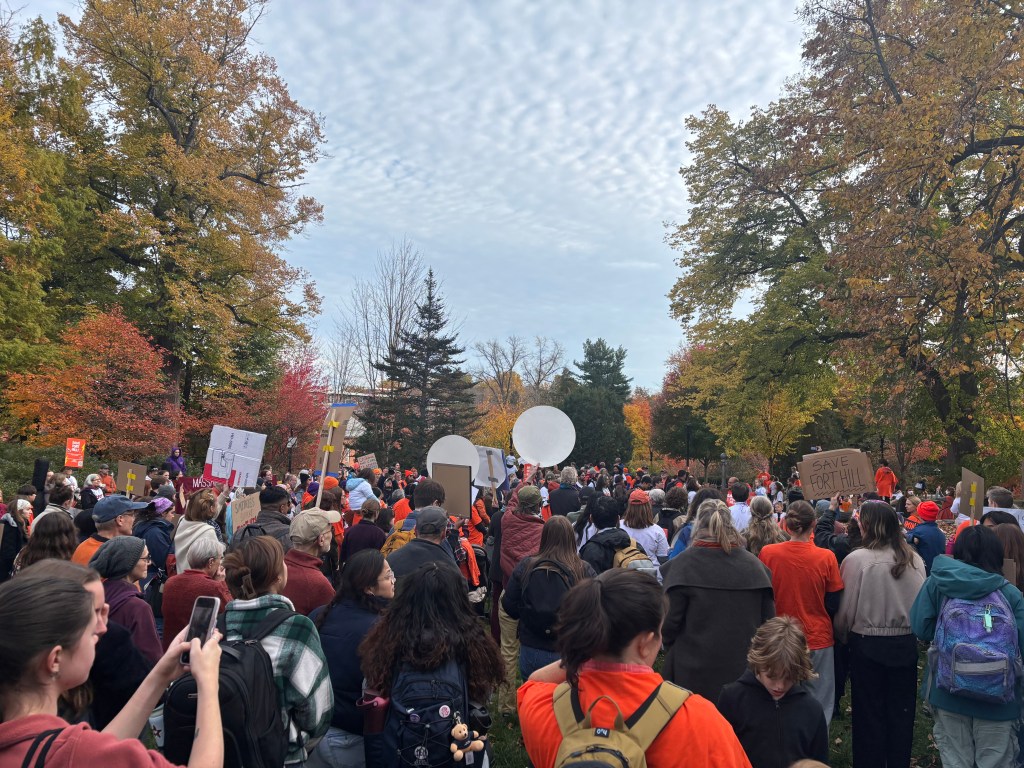
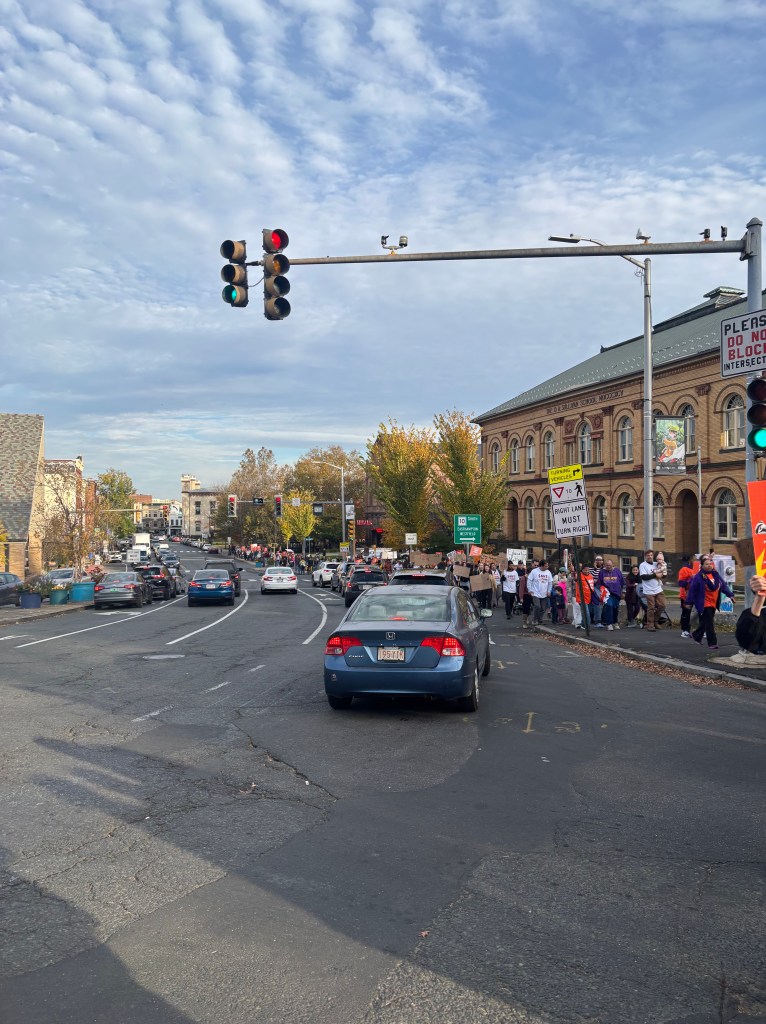
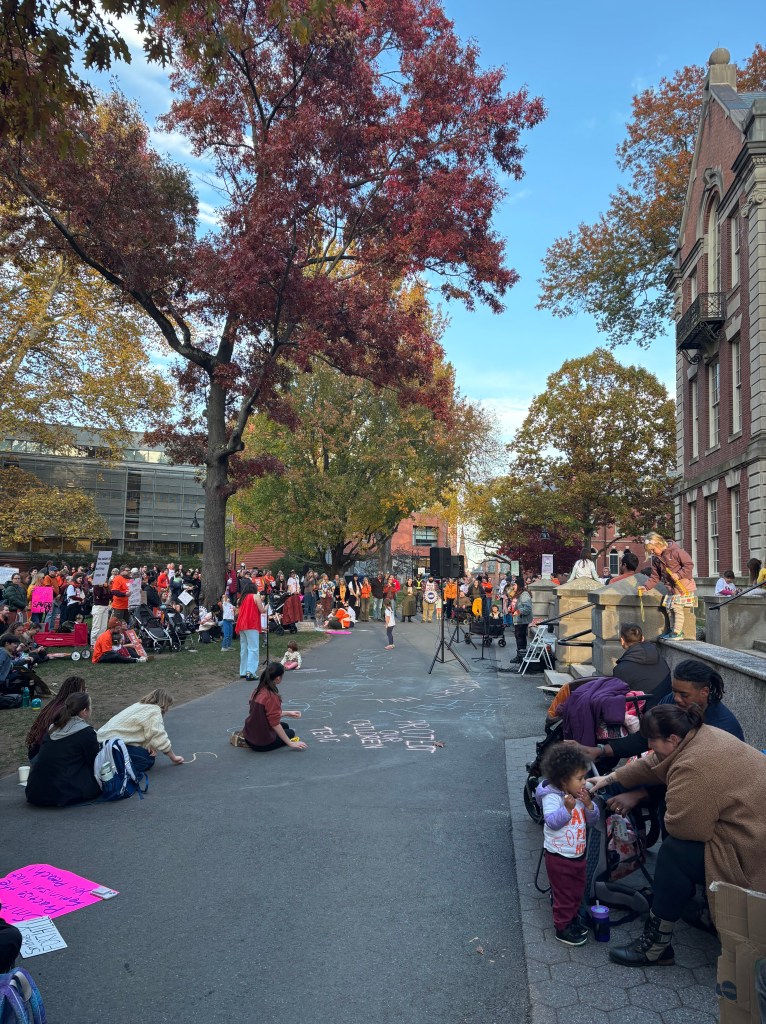
- The mass community mobilization in defense of Fort Hill, led by the Teachers Association and other union allies, drew hundreds to the streets on October 28th. It was a tremendous moment of unity that I was proud to join!
Recent council (and misc. city) business
- The October 15th city council meeting featured a presentation on the severe deterioration of the E. J. Gare parking garage downtown. The garage is now structurally unsound to the point of requiring constant monitoring; the top three floors are unusable.
- The private engineering firm contracted for review of the building identified three primary options for the city, along with tentative cost assessments:
- Temporary repairs to the existing building, which cannot fully stop the deterioration of the concrete; ~$7-10M
- Demolition and replacement with a surface-level parking lot; ~$3-4M (city loses a total of ~320 public parking spots compared to the original maximum capacity of the garage)
- Demolition and construction of a new garage of the same size; ~$18-33M
- There are no good options here. The economic strain on all sectors — especially local workers and residents — will be significant, and exacerbated by the limited, regressive means of funding (such as a debt exclusion) that the city government has at its disposal. The loss of parking will have dramatic effects on the city.
- As councilor Meg Robbins pointed out after the October 15th presentation, the city’s permission of any parking in the garage is questionable given the structure’s instability.
- The significant additional strain on municipal finances and city infrastructure should decisively sink the notion of the Main Street redesign as currently proposed.
- The Sciarra administration has treated state allocations to the city under Chapter 90 (subsidies for road and highway repairs) as a “bank”, short-changing services by using general-fund revenues to pay for road maintenance while saving up Ch. 90 monies. The administration does not maintain centralized records of capital spending, does not publicize reserve account balances and has not disaggregated the constituent funds within the Ch. 90 umbrella (which include allocations from the state’s Winter Recovery Assistance Program for the expenses of last winter). As such, the city’s current resources for remediation aside from a debt exclusion or ex-machina state funding are unclear.
- The suggestion of seeking a public-private partnership to supposedly reduce the costs of the garage is unacceptable under any circumstance. The notion is particularly egregious without a serious public review of the fiscal parameters named above.
- The private engineering firm contracted for review of the building identified three primary options for the city, along with tentative cost assessments:
- The Fiscal Assessment Community Task Force (FACT Force/override committee) held its final public hearings this month. While no public announcements have been made yet, committee members have indicated that the Sciarra administration plans to propose language for the override question in December, leading up to a public vote in March.
- Key figures in Northampton’s Democratic political machine, including mayor Sciarra’s husband, have been meeting at the police station — effectively in secret — to organize the “yes” campaign for an override.
- WMCP has consistently argued that the only possibility of passing an override in this context is with serious concessions to the working-class and progressive alignment in the city. Organizing the override campaign under the table based on inside knowledge undermines the already-limited public legitimacy of the FACT Force, and preempts a process of negotiation that can ensure the continued funding of essential services.
- With the Democratic machine refusing to back down from the $12M+ municipal costs of the Main Street redesign amid a fiscal crisis, it is clear that, should an override fail, this administration is open to carrying out catastrophic cuts to public services to impose its flagship project on the city. To reiterate, this is a hostage crisis where workers, youth and students are set to pay the price.
- At the October 27th hearing, councilor Rachel Maiore emphasized that the public hearings alone were not sufficient to reach the widest possible audience, and that a campaign will need to meet residents where they’re at — physically and politically.
- WMCP maintains the general necessity of overrides as a stopgap to sustain the provision of public services. In Northampton, this is due to both structural factors of the fiscal crisis and the profound, anti-popular mismanagement of public funds by the incumbent government. Though overrides are effectively an inevitability until Proposition 2½ is abolished, the misuse of public monies — such as with the Chapter 90 funds detailed above, and as covered in previous editions of this newsletter — is not. It is imperative that we elect a strong labor-progressive slate in next year’s municipal elections.
- Key figures in Northampton’s Democratic political machine, including mayor Sciarra’s husband, have been meeting at the police station — effectively in secret — to organize the “yes” campaign for an override.
- Following a public hearing, the council voted unanimously to add its annual consideration of a differential property tax rate to the consent agenda of its Nov. 5th meeting.
- Under state law, cities and towns are allowed to rebalance their overall tax levy between residentially- and commercially-zoned properties, so long as the total levy itself is not changed (among other key parameters). Each municipality must review its tax rate annually.
- Given the broader exemptions process for smaller commercial properties, opposition to a split rate favors large landlords and corporations over residents, and tenants in particular. In the context of the upcoming override vote, a willingness to split the tax rate to modestly reduce the fiscal pressure on residents would be a much-needed gesture of good faith.
(Additional) recent labor news
- Over 250 workers in the Massachusetts Society of Professors (MSP), Professional Staff Association (PSU) and University Staff Association (USA), all affiliates of the Massachusetts Teachers Association (MTA), rallied at UMass Amherst on October 22nd to demand fair wages from the university administration.
- The university has been consistently reticent to meet workers’ economic demands, and its efforts to impose surveillance technologies on workers have developed rapidly in recent months. Last month, USA successfully fended off the unilateral implementation of “Kronos” software, which was intended to make workers’ locations and other sensitive information available to management.
- The unions will take their fight to the state legislature on November 20th — if you want to join, you can RSVP to take the bus there at this link.
- Continuing on the theme of education, the MTA and a broad coalition of public education advocates have been calling for the Healey administration to reject the voucher deal included in the “Big Beautiful Bill”. The Boston Globe, a longtime ally of the charter school lobby, has taken part in the far-right effort to pressure Healey into signing on, ratcheting up the Trump administration’s campaign to destroy public education entirely. You can read more about the disastrous provisions of the voucher program here, and sign on to the petition opposing the voucher program at the links above.
That’s a non-exhaustive wrap for this month! For everything I didn’t cover, and for general thoughts or questions, you can reach me by email at lukerotello@gmail.com or by phone at (413) 404-0405. Stay safe, stay healthy and stay in the struggle!
-Luke


Leave a Reply