Hi, happy Pride!
Despite the worsening political conditions across the country, especially the increasing threats of imperialist escalation against Cuba, it was a great joy to bring a class content to Hampshire Pride just hours after the May Day demonstration in Holyoke (filed under “recent labor news” below). WMCP joined the UAW and broad labor contingent, and hosted a table after the march. It was humbling and heartening to encounter so many friends and allies from different progressive movements, and to bring the urgent working-class analysis of this moment to an event full of communities seeking it. Thank you for the many rich, insightful conversations — and to the resident of Southampton who had fingers crossed for the override, congratulations!
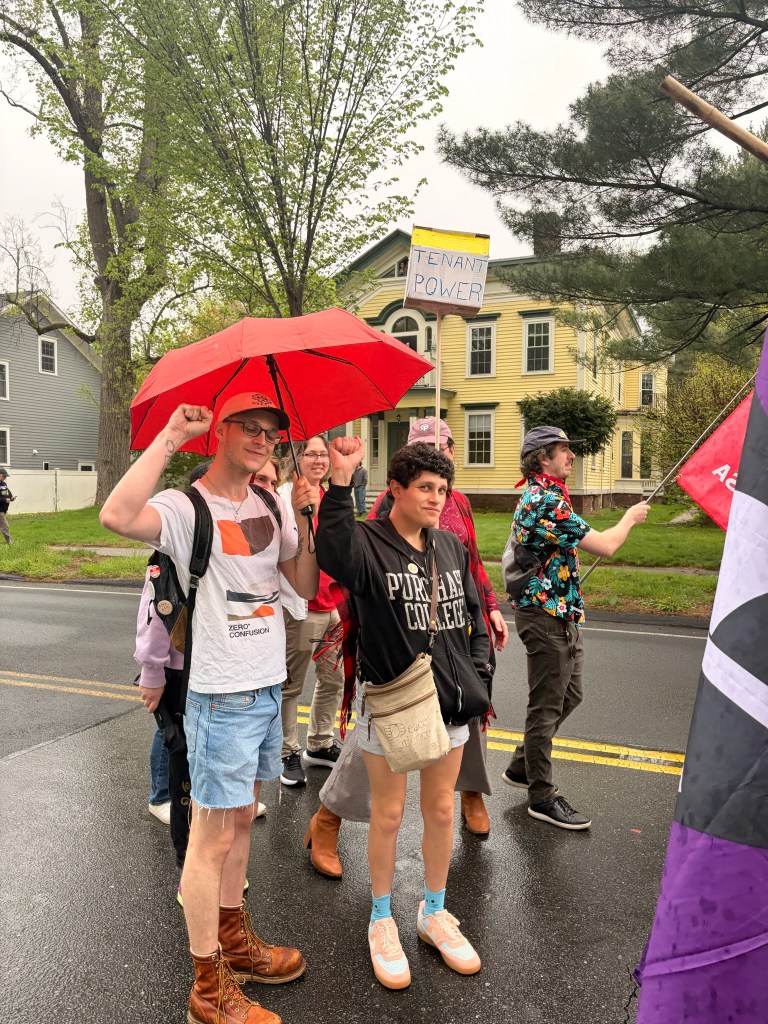
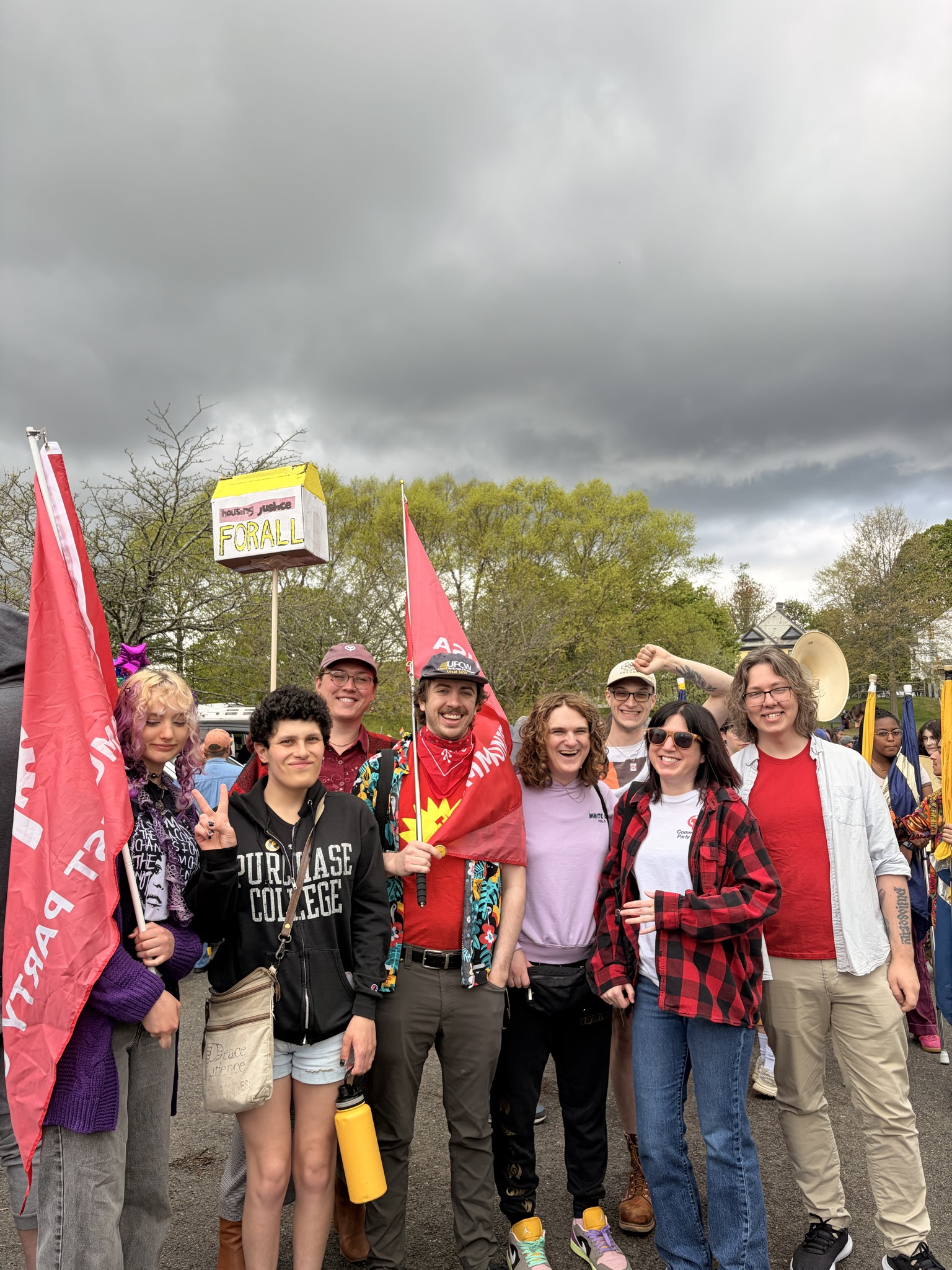
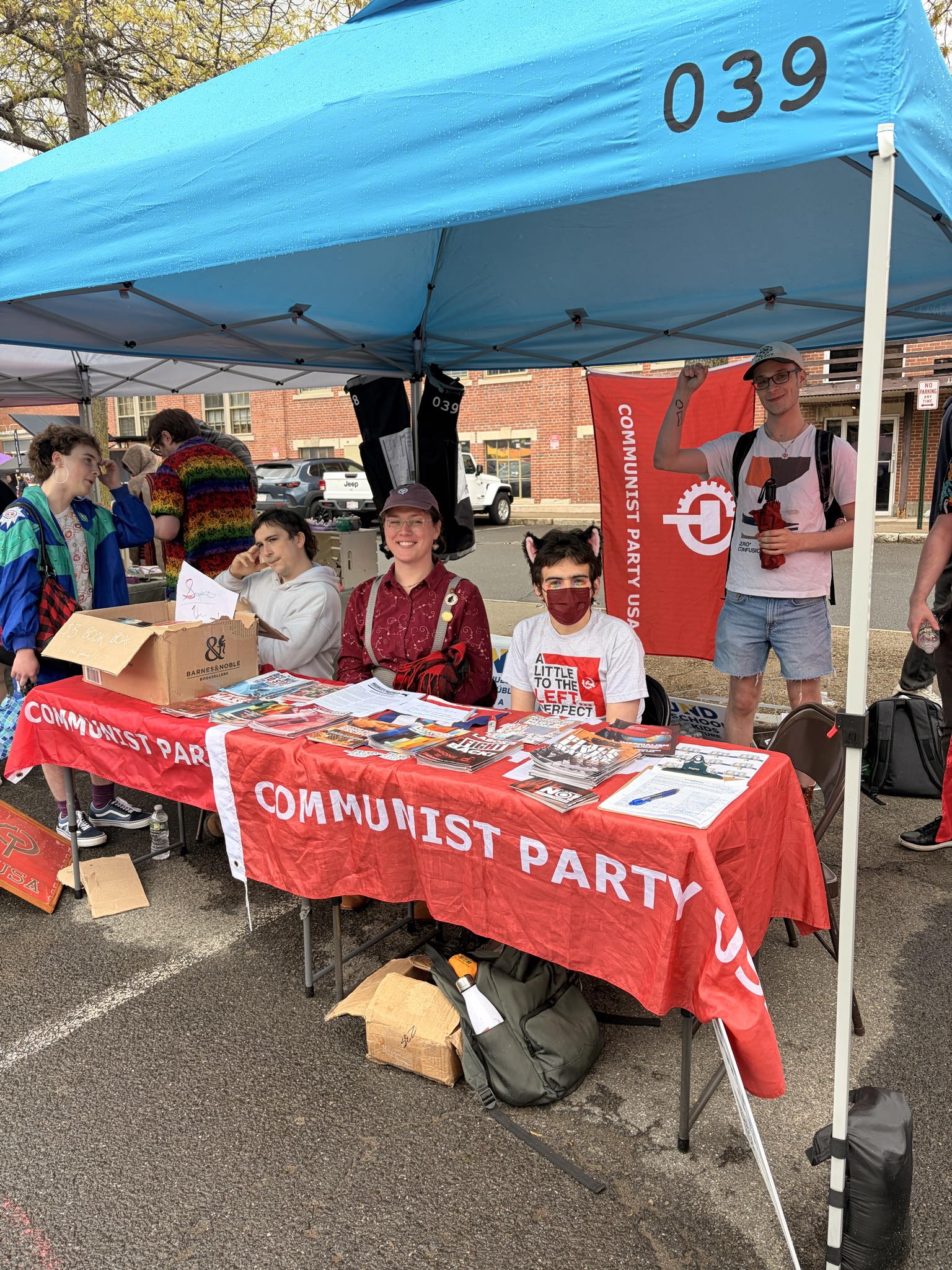
As one component of bringing the working-class view to the fore, we are collecting signatures (seen on the clipboard in the last picture) to call for Smith College to agree to a PILOT program with the city of Northampton. By this time next month, you will be able to read more and add your own name onto the petition on our website!
On a different note, the “elected officials” Pride contingent quickly turned into a photo op for the Healey-Driscoll gubernatorial campaign, as Lt. Gov. Kim Driscoll attended and spoke at the event. This is part of a pattern of local political activity, where public institutions (and with them, public resources) are used for the organization of the Democratic party. For instance, in the case of the city’s Youth Commission, prior meeting agendas have included planning for the formation of a Young Democrats chapter at NHS. This should stand as a point of reference when Mayor Sciarra and her allies on the council blame declining state aid and stalled Chapter 70 reforms for our city’s fiscal crisis — to the substantial extent that this blame is well placed, our city’s Democratic machine is out campaigning with its own scapegoats!
With that said, let’s focus on the main political substance in the city this month: Northampton’s $152M proposed FY27 budget, first released on May 15th. As such, I’ll dedicate an additional section to some key takeaways, and will apologize in advance for the length of this edition.
Key budget takeaways
- [Formatting note: if not linked, sources for the claims below can be found within the FY27 budget itself, linked above. If you need help finding where these figures are listed or just understanding the document, let me know — I’m happy to find some time to talk through it with you.]
- Note the two public hearings on different components of the budget: the first has taken place already, on May 27th, covering the Information Technology Services Department (ITS), the Department of Health and Human Services (DHHS) and the School Department. The second public hearing, with presentations from remaining departments, will take place on June 2nd at 6pm in council chambers (meeting link and agenda TBD).
- The narrow timing of budget votes is cause for concern: there are only two days between the June 2nd hearing and the June 4th general council meeting during which a final vote on the budget is set to take place. The charter mandates deliberation on the budget no more than 45 days after its initial presentation to the council — with its first presentation to the public on May 15th, and its first presentation to council on the 21st, there is no rush except insofar as our mayoral administration wants to avoid scrutiny over essential public-school positions left unfunded in this budget.
- The frequent question of “where will the money come from?” is, by design, much more difficult to answer when councilors and the public alike have a matter of hours to assess priorities and receive input from constituents before finalizing their decisions!
- The narrow timing of budget votes is cause for concern: there are only two days between the June 2nd hearing and the June 4th general council meeting during which a final vote on the budget is set to take place. The charter mandates deliberation on the budget no more than 45 days after its initial presentation to the council — with its first presentation to the public on May 15th, and its first presentation to council on the 21st, there is no rush except insofar as our mayoral administration wants to avoid scrutiny over essential public-school positions left unfunded in this budget.
- With the recent revelation of over $4 million of municipal funds going into the Picture Main Street project (per a letter shared with the city council following the May 18th presentation on the project to the community resources committee), and broader public distrust of government spending permeating local- and state-level discourse, the prospects of an override next year look tenuous at best.
- In her budget message, mayor Sciarra indicated that she intends to submit an override proposal as a de facto referendum on the Fiscal Stability Plan. As mentioned in last month’s newsletter, her own supporters do not believe it will pass on such terms.
- I, and we as the Communist Party, will never campaign against funding for public services. At the same time, we utterly reject the hostage situation taking shape, in which our city administration and Democratic machine tacitly acknowledge the ongoing collapse of their mandate while attempting to take working people down with them. We will not stand for this administration setting up a vote to fail on the backs of workers and students — the mayor and council must accept the end of the Fiscal Stability Plan and legally bind all revenues sought within the override to the funding of public services, particularly education.
- Over $4.3 million of municipal funds will go to school-choice and charter school assessments levied on Northampton. This marks a combined 12.6% increase over FY26, while state rebates to charter expenses and from incoming school choice (totaling ~$1.8M) have declined by 5.8% in the same period. That’s $4.3M in public funds, and a net loss of $2.5M (~1.8% of all general fund expenses) going toward the systematic privatization of public schools.
- As with countless other communities across Massachusetts, our state’s health insurance cartel is squeezing our budget in increasingly extreme and unsustainable ways. The total cost has climbed to $16.6M, or 12.8% of general fund expenditures. This accounts for a roughly $1M (6.7%) increase from FY26.
- Our city, as with many others in the region, negotiates for public-sector healthcare through the Group Insurance Trust, which is a form of compromise with the health insurance industry enacted under state law. Many municipalities in Massachusetts are facing double-digit increases in healthcare costs, driving override votes in all corners of the state.
- Our city council has historically stood with calls for single-payer healthcare, including last year’s unanimous resolution in support of Medicare for All. Though our city’s leadership in this struggle is commendable, and this is a general point of agreement among nearly every organized political force in the city, it will take a statewide mass movement to defeat the private insurance lobby. For more information on how to get involved in building the single-payer coalition, please feel free to reach out to me or visit masscare.org.
- The root of this crisis is shared with the deepening, general crisis of capitalism in this moment and the concurrent rise of the fascist MAGA movement. The broad-spectrum increase of expenses, and the rise of health insurance costs in particular, is not (solely) a consequence of “greed” or other moral diagnoses, but rather the general tendency of the rate of profit to fall. In short, the health insurance cartel is motivated by crises in its circulation of capital, and the same must be said of the Trump administration — the capitalist interests it represents have turned to fascism as an effort to place their contradictions onto our backs.
Other council business
- By 7-2 vote (councilors Robbins and Stratton opposed), the council passed the duplex zoning amendment, exempting a wider range of developments from site plan review. A link to the exact text of the measure and my commentary on it are available in last month’s newsletter here.
- Some councilors voting in favor, including councilor Davis in Ward 5, indicated that they had heard from residents who have faced harassment and intimidation by the same local developers pushing for this measure, and felt that the constituent input was irrelevant.
- Other councilors indicated, particularly in reference to the joint meeting of the legislative matters subcommittee with the planning board on this subject, that they believed abutting property owners could generally work out disputes on their own.
- Not only is this demonstrably false, but it also (intentionally) misses the point: the consequences of these developments extend far beyond the properties literally adjacent to them. When a new development increases the value of one property, the entire neighborhood sees a corresponding shift. When a developer sidesteps regulations, violates workplace or environmental safety laws, etc., it impacts the health and safety of everyone in the area, with broader political consequences and precedents that impact the entire city.
- The school committee is set to consider a measure to opt in (Chapter 329 of the Acts of 1987, granting the city council power to increase the school department budget), with details TBD. As this is a power first recommended by the school committee and then taken up for deliberation by the council (and requiring the assent of the mayor), the council will have discretion on when to bring the measure forward.
Recent labor news
- The 2026 May Day celebration in Holyoke, part of demonstrations nationwide, was the largest in living memory. With hundreds in attendance from dozens of participating unions and local organizations, anchored by the Holyoke Teachers’ Association (HTA), the spirit of working-class political leadership is coming to life across the Valley. Educators (including representatives of NASE!), home care workers, building trades workers, and others delivered speeches emphasizing the history and importance of May Day as a workers’ holiday. The video below captures one moment of the fighting spirit, which catalyzed a renewed energy in HTA’s negotiations (see below). It brought the day back to its roots: the demand for working-class leadership of society and the imperative of a broad coalition — led by working people — against fascism, austerity and imperialist war.
- Continuing with the HTA, Holyoke public educators have their first contract since the district existed receivership, after over a year of bargaining. This contract secures a reduction in overall working days, a yearly cost of living adjustment (COLA), stronger language protecting the health and safety of students and staff, and much more. Congratulations!
- Educators’ struggles for dignity, safety and stability at work haven’t just come in the public sector, either: workers at Square One in Springfield, an early education nonprofit, are calling for management to bargain in good faith, and rejecting illegal threats of termination for their organizing.
- Northampton has several private pre-K and early education institutions organized with UAW 2322, including Nonotuck Community School on Riverside Dr. in Ward 5. This negotiation sets further precedents for the rights of all nonprofit workers and educators in the Valley, particularly those in early education. I will share further updates in next month’s edition.
- 1199SEIU members will hold a rally outside of Cooley Dickinson on June 4th, 12-4pm as they fight for a fair contract. I’ll be joining them — hope to see you there too!
Thank you for bearing with me in this longer-than-usual, still-not-comprehensive recap! As always, you can reach me any time at lukerotello@gmail.com or (413) 404-0405. Stay strong, stay healthy and stay in the struggle!
-Luke
This post has been edited to include recent information about the 1199SEIU rally at Cooley Dickinson.


Leave a Reply